For triathletes and open water racers stuck between 2:00 and 2:30 per 100m. Built for adults who came to swimming late. Not kids. Not pool squads.
The Freestyle Blueprint

Break 2:00 — and hold it
for the whole swim.

The complete freestyle rebuild I use with my personally coached swimmers — now yours, module by module. Exhausting to effortless, so the pace you finally find is one you can actually keep.

Start The Blueprint — $29 First Month

Then $67/month. Cancel anytime, no lock-in.

15 years coaching adult swimmers  •  20,000+ swimmers helped  •  Ex-Olympian

I'll say this as plainly as I can: The Freestyle Blueprint is the most complete thing I've ever built. It's everything I do when someone pays me to personally rebuild their freestyle, laid out module by module in the order I'd actually teach it.

I've coached thousands of adults who came to swimming late, and the pattern almost never changes. You're fit — you run and ride with people you can hold your own against, sometimes beat. Then you get in the water and those same people disappear up the pool. You're somewhere between 2:00 and 2:30 per 100m, you've been there for years, and when you try to swim faster you mostly just get more tired.

You train mostly on your own, so nobody has ever watched you swim and told you what's actually wrong.

A while back I asked five hundred swimmers a simple question: how much faster have you got since you started trying to improve?

Of the ones who gave me a number, two thirds had gained ten seconds or less. Sixty-nine of them said they'd gained nothing at all. Another fifty didn't know, because they'd never measured it.

These aren't lazy people. They swim three and four times a week. They've bought the programs, watched the videos, and plenty of them have paid coaches. Years of work, ten seconds.

And here's why. Ask those same swimmers what's actually holding them back and the honest answer is "technique" or "I don't know." That's not a failing — you can't see yourself swim. But it's exactly why the effort hasn't moved the clock. You can't fix a problem nobody has named, so you end up working hard on the wrong things.

The Blueprint fixes that in order: what's wrong, why it's wrong, and what to do about it — every piece of efficient freestyle, built to hold together.

And I know what you're actually after here. It isn't a number on a watch. It's coming out of the water with the pack instead of behind it. It's the swim leg stopping being the thing you apologise for. It's getting on the bike with something left in the tank, knowing your race didn't start at T1.

— Carl

Try this before you decide anything

Are you faster with a pull buoy?

Put a pull buoy between your legs and swim 100m easy. Compare it to your normal 100m.

If you're faster with the buoy — and roughly three out of four adult swimmers who've tested it are — your legs are sinking. The buoy is lifting them for you. Which means you're not slow because your arms are weak or your fitness is short. You're slow because you're dragging an anchor, and every stroke you take is fighting it.

That's why more yardage hasn't worked. Why the catch drills didn't stick. Why you can hold a decent pace for 100m and then watch it fall away over 1,500. You can't out-pull a body position problem, and you certainly can't out-pull it for an hour.

If you've never tried it — most swimmers haven't — go and find out this week. It's the fastest free diagnostic in swimming.

This is where The Freestyle Blueprint starts, on purpose. Position first, because until your legs come up, nothing else you fix can hold. Then breathing, kick and timing. Then the arm pull. Then speed and race day. Here's how the whole thing is built.

Inside The Freestyle Blueprint

Every piece of efficient freestyle.
Nothing missing.

Eleven modules, organised into four build phases — the same progression I take my privately coached swimmers through. Each phase locks in before the next one starts, which is why this holds when years of scattered drills didn't. Most swimmers give it four to five months end to end — because you're rebuilding a stroke, not watching a video course. You've been stuck for years; a few months to fix it properly is the best trade you'll ever make on your swimming.

1

Position In The Water

Where every stuck swimmer starts. Get your legs up, get level, and stop dragging an anchor down the pool. This is the phase that makes the pull buoy unnecessary — and the one that makes everything after it possible.

2

Breathing, Kick & Timing

The rhythm of the stroke. Breathe without stalling, wrecking your alignment or gasping by the second length. A kick that holds you up instead of burning you out. And the timing that ties your arms, hips and breath into one movement rather than three.

3

The Engine — Your Arm Pull

Now you're level and rhythmic, we build the part that actually moves you. Catch, hold and pull — so the effort you're already putting in turns into forward motion instead of spinning the wheels. This is where the pace drops hard.

4

Faster & Further — Speed, Open Water, Race Day

Making it survive the real thing. Holding your new stroke when you're tired, in a wetsuit, in chop, with people swimming over you. Pacing, sighting and race craft — so your open water pace stops being slower than your pool pace.

You go at your own pace, and most swimmers feel the difference inside the first phase — then see it on the clock soon after. For once, each fix is holding the next one up instead of fading on its own.

And if your open water pace is slower than your pool pace — which it is for most triathletes — that gap is technique, not fitness. A stroke that only holds together with a black line and a wall falls apart in a wetsuit, in chop, with people swimming over you. The later phases build a stroke that survives race day.

If you learned to swim late and you race tri or open water, this was built for you. Not adapted from a kids' squad program. Not watered down from elite training. Built, from the first module, for the adult body, the adult schedule, and the races you actually do.

You're not doing this alone

Included while you work through it.

Most adult swimmers train entirely on their own — nobody watching, nobody to ask. The Blueprint is the main event, and these make sure you're not doing it in silence.

💬

My Weekly Thread

Stuck on a module? Ask me directly. Every week I answer member questions — your stroke, your race plan, your sticking point. A course with a coach attached.

🏊

Three Live Sessions Every Week

Posted fresh each week so you always have a session ready — and each one gives you a place to practise what you're building in the Blueprint. Swim them on your schedule, compare notes in the comments if you feel like it.

🩺

Technique Dr

Describe what's happening in your stroke and it points you to the right module, problem video, and drill. Built from 15 years of my coaching — so you're never guessing what to work on.

📅

Program Planner

Got a race coming? It builds your training program from today to race day, updating each week — with the Blueprint work woven into your sessions.

From swimmers I've coached

Swimmers who learned late — and finally cracked it.

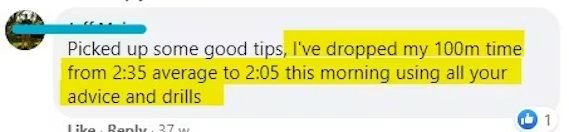
2:00 to 1:52 — in just 4 sessions
Swimmer testimonial - 2:00 to 1:52 per 100m
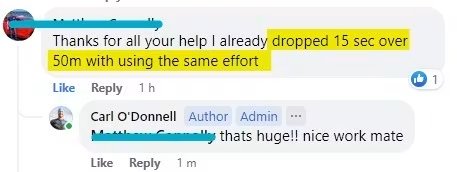
70.3 swim 10 minutes faster than his Olympic tri
Swimmer testimonial - 70.3 swim 10 minutes faster
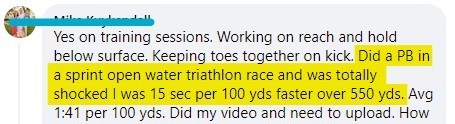
Race PB — 15 sec/100yds faster in a sprint tri
Swimmer testimonial - sprint tri PB
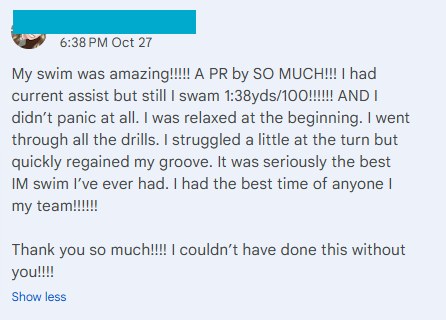
Best Ironman swim ever — 1:38/100yds
Swimmer testimonial - Ironman swim PR
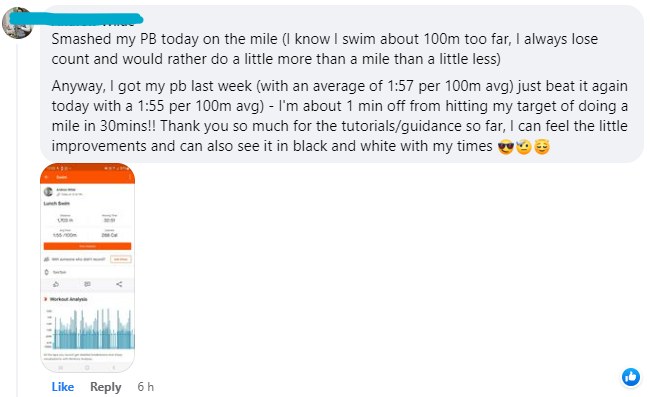
Two mile PBs in one week
Swimmer testimonial - mile PB
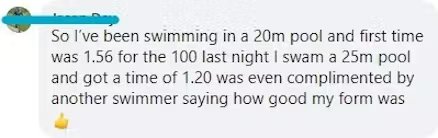
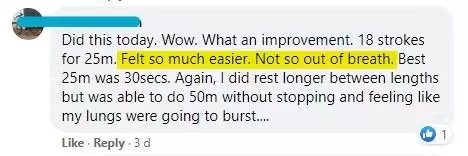
1:50 to 1:35/100m — and 6 fewer strokes per length
Swimmer testimonial
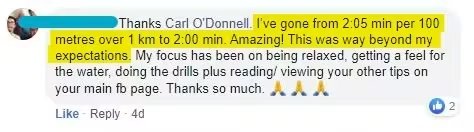
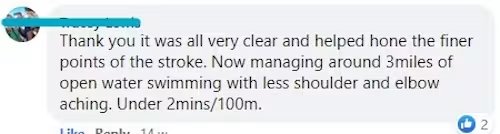
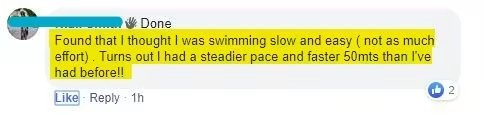
2:05 to 2:00 per 100m — held over a full kilometre
Swimmer testimonial
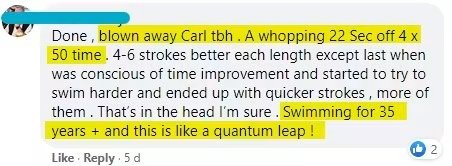
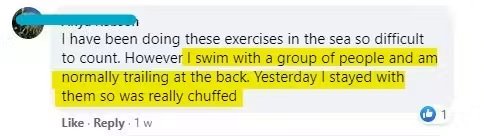
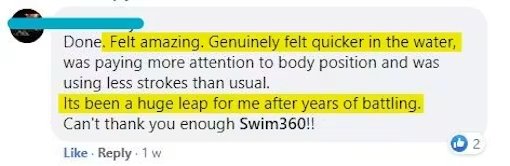
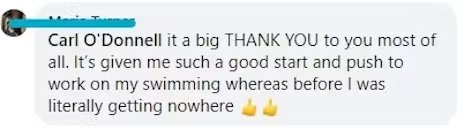
"A quantum leap" — after 35 years of swimming
Swimmer testimonial
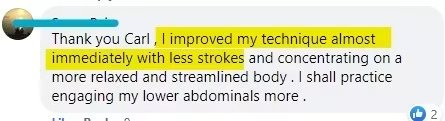
Swimmer testimonial Swimmer testimonial Swimmer testimonial Swimmer testimonial Swimmer testimonial Swimmer testimonial Swimmer testimonial Swimmer testimonial Swimmer testimonial Swimmer testimonial Swimmer testimonial Swimmer testimonial Swimmer testimonial Swimmer testimonial Swimmer testimonial
"Why monthly for a course?"
Because it puts you in control of what you spend. Work through it in two months, pay for two months — that's still less than one session with a private coach. Stay longer for the weekly sessions, the thread, and the tools, and it keeps earning its keep. No lock-in, cancel in one click. You decide what it's worth, month by month.
"I've already had coaching and it didn't fix it."
Most swimmers who come to me have already tried something — a club, a coach, a video analysis, an online program. Two things usually went wrong. They got told what to do without being told what was actually wrong with their stroke, and they got given pieces in no particular order. The Blueprint does the opposite: it diagnoses first, then builds in sequence, so each fix holds the next one up. And you've got me in the weekly thread when you get stuck.

Your next race is coming

Exhausting to effortless.
Held to the finish.
Properly. For good.

First month

$29

then $67/month

Cancel anytime, no lock-in.

What it usually costs in total: most swimmers take four to five months to work through the Blueprint. That's around $270–$340 — less than one 70.3 entry, and less than three sessions with a private coach. For a stroke you keep for the rest of your racing life.

  • The Freestyle Blueprint — 11 modules across 4 build phases
  • My weekly thread — ask me anything, get unstuck
  • 3 new live sessions every week
  • Technique Dr — diagnoses your stroke, any time
  • Program Planner — your training built to your race
  • Members' community
Start The Blueprint — $29 First Month

Secure checkout. Instant access.

🛡

Work phase one. If nothing changes, leave. I'd rather you tested this in the water than took my word for it. Work through the first phase, swim it, and see whether your body position shifts. If it doesn't, cancel in one click — no lock-in, no email to write, no questions asked.

Privacy Policy

Last updated: July 2026

Swim360 Coach collects your name and email when you sign up. We use this to manage your membership and send relevant communications. We use MailerLite for email and Stripe for payments. We do not sell your data. Cancel your membership any time. Contact us at coach@swim360.coach for any privacy requests.